Safety Standards: Plan the Work, Then Verify the Requirement
Question: How can a team record safety requirements without treating a checklist as proof of compliance?
1. Create a structured standard
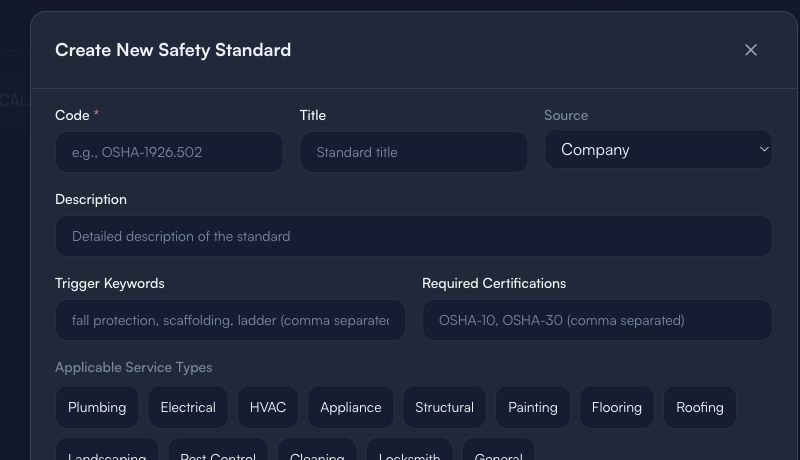
This is an empty form with generic examples only. It does not show a live site, technician, certification, customer, incident, or job record.
Use each field for one clear purpose:
- Code: use a reference your responsible reviewer recognizes.
- Title: give the requirement a plain-language name.
- Description: record what must be checked or controlled.
- Trigger Keywords: make terms easy to find; do not treat keywords as automatic decisions.
2. Scope the standard deliberately
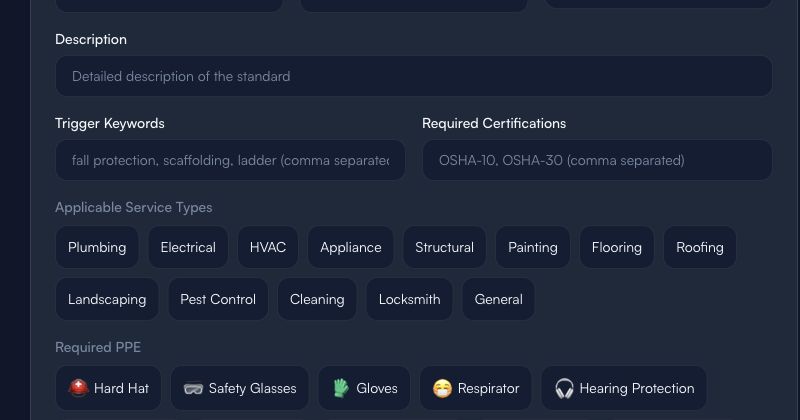
The options in this visual are generic UI examples, not a verified requirement for a particular job, team, location, or person.
Before using service types, certifications, or PPE fields:
- Confirm the requirement applies to this exact work.
- Verify the source is current and approved for your location.
- Do not assume a label is a completed qualification.
- Escalate uncertain or consequential decisions to the qualified owner.
3. Keep a human checkpoint
Use this planning flow:
Requirement → Work context → Qualified review → Documented decision → Safe handoff
Do not publish or paste incident details, personal medical information, access instructions, credential numbers, or client-specific conditions into public content.
Limitations
This guide and the Safety Standards screen are not legal advice, a safety certification, a substitute for required training, or evidence that a job complies with any law, regulation, code, or insurance requirement. Obtain qualified review for consequential decisions.
Next: Work Orders guide · Guides & Tips